


Image Library: the AI sales, quoting and marketing app a whole team runs on
A living portfolio for sales, photos, guides and videos for quotes, Meta, Google, Shopify and GA4 in one place, AI built in and access set per role.
An AI back office I built for the marketing of the Glass Railing Store, a Shopify store for frameless glass railing in Canada. Fifteen agents in six rooms read the store’s data on a schedule, hand their work from desk to desk and check each other, so I can also double-check my team’s work and compare their reports with what the agents find. A General Manager agent reviews every room and checks every agent each morning, and every move that matters waits for my yes.
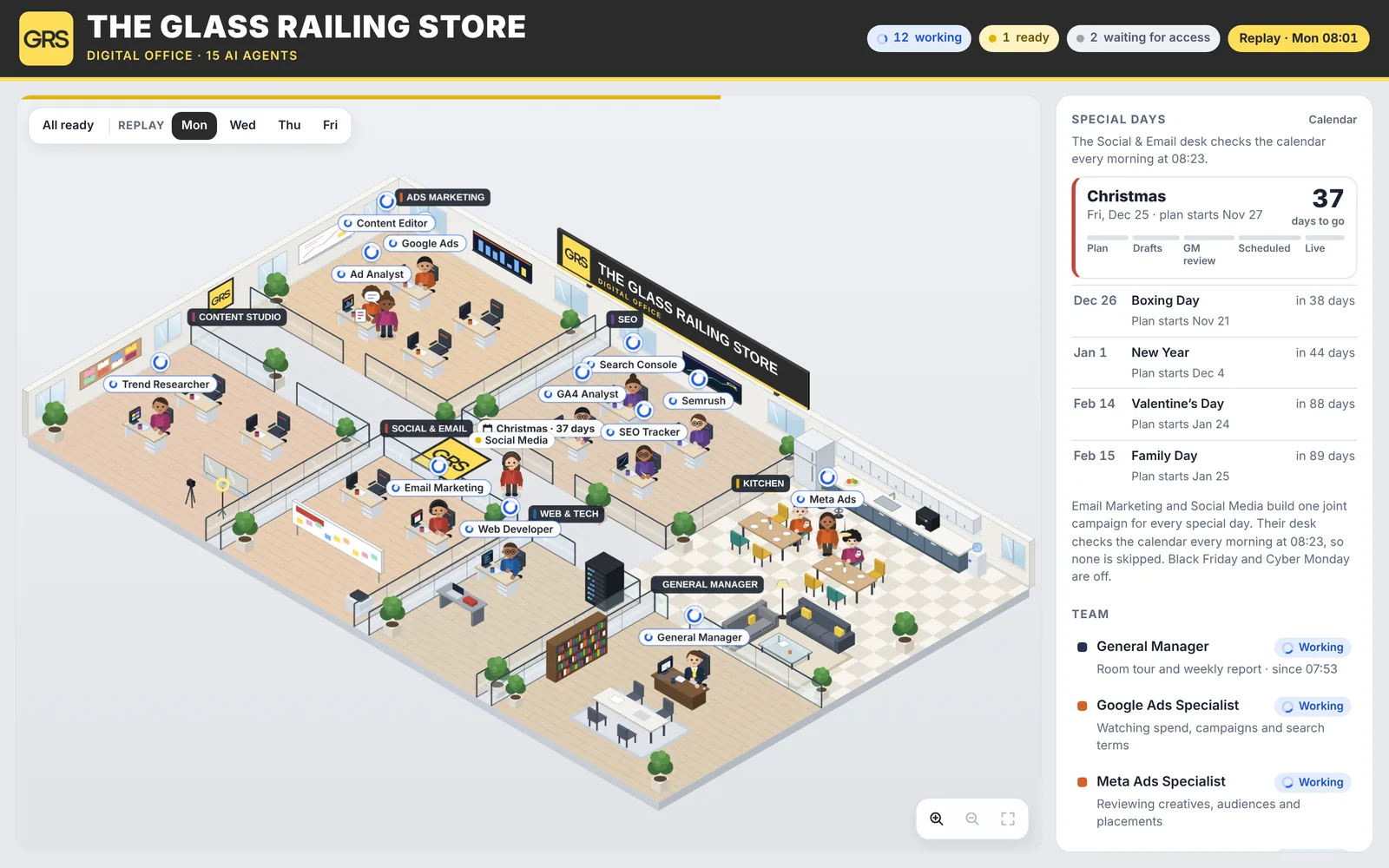
Opens in a full-screen window on this page. You stay on this site the whole time.
A small online store runs on a dozen dashboards: ads, analytics, SEO, email and social. Checking them every day takes hours, and the signals that matter are easy to miss: an ad quietly burning money, a page slipping in search, a post that people actually save and share.
So the store got an office instead of another dashboard. Every desk is an AI agent with one job, a fixed schedule and clear limits. The agents read the store’s data, write what they find into shared documents, hand their work to the next desk and check each other. I get a short list of decisions, and nothing reaches customers, ad accounts or the live website without my yes.
It is also a second pair of eyes on my team: the agents read the same data as the people who do the work, so I can double-check the team’s work and compare their reports with what the agents find before I decide.
Every instruction is written as a job description: the role, the data to read, the output format, the thresholds and the hard limits. The times are Toronto time.
The most important link in the office runs between the Ad Analyst and the Content Editor. Together they decide what content gets made, and real engagement data decides it, not guesswork.
The General Manager can approve the green work: analysis, reports and plans; drafts of content, email, product metadata, designs and social posts; small fixes inside department documents; test plans on a copy of the theme. The red work waits for me: publishing on social, sending email, ad budgets, bids and campaigns, prices and discounts, live site changes, new access or connections, deleting anything, and orders, payments and customer records. The one exception: the Blog Creator may publish a post once the General Manager has reviewed it. I answer each decision in the weekly report with approve or reject; green items with no answer after 48 hours are approved by the General Manager, and red items always wait.
Whatever I send or ask goes to the agent whose job it is, and only that agent handles it; an agent that gets something outside its job names the right desk instead. Agents never give each other work directly, and they never connect tools or sign in anywhere themselves: every document ends with “what would help me do better”, and the General Manager brings the requests to me.
Each desk with its own schedule is a scheduled Claude task: a fresh session starts at a set time, does its job and finishes, and the SEO desks work inside the General Manager’s Monday run. The data comes from Shopify (read-only), Google Analytics 4, Google Search Console, Google Ads and Meta Ads through Windsor.ai, Semrush and Metricool, and the photos and footage from Google Drive. Work travels between desks as shared documents (the ads analysis, the trend brief, the content plan, the drafts, the email draft and the weekly report), and agents only add notes to their own documents. The SEO Project Tracker writes to the SEO specialist’s task board through its own connector, and the board can start it the moment the specialist saves an update. It is the kind of system I build in AI automation, beside the Image Library the same team works in.
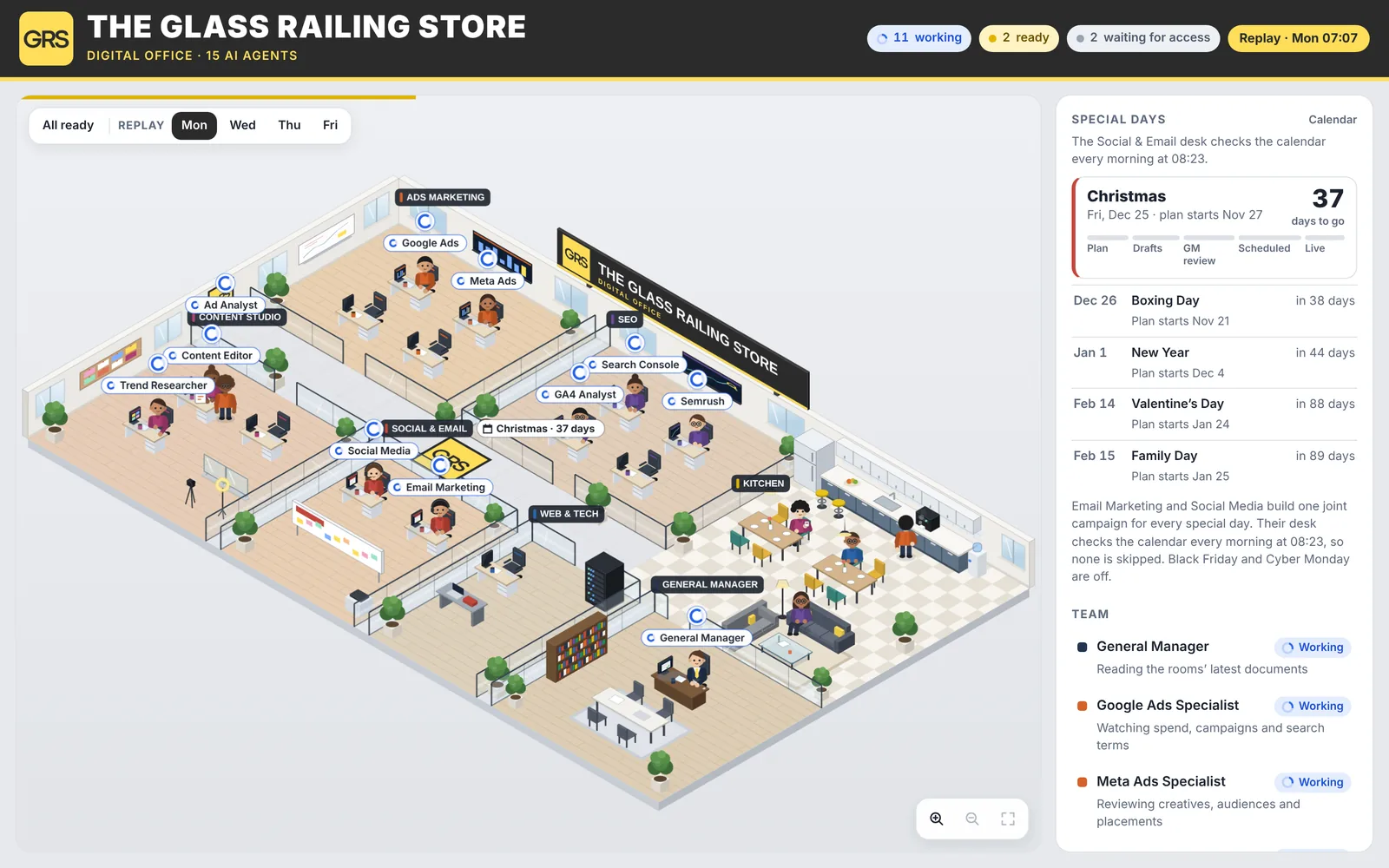
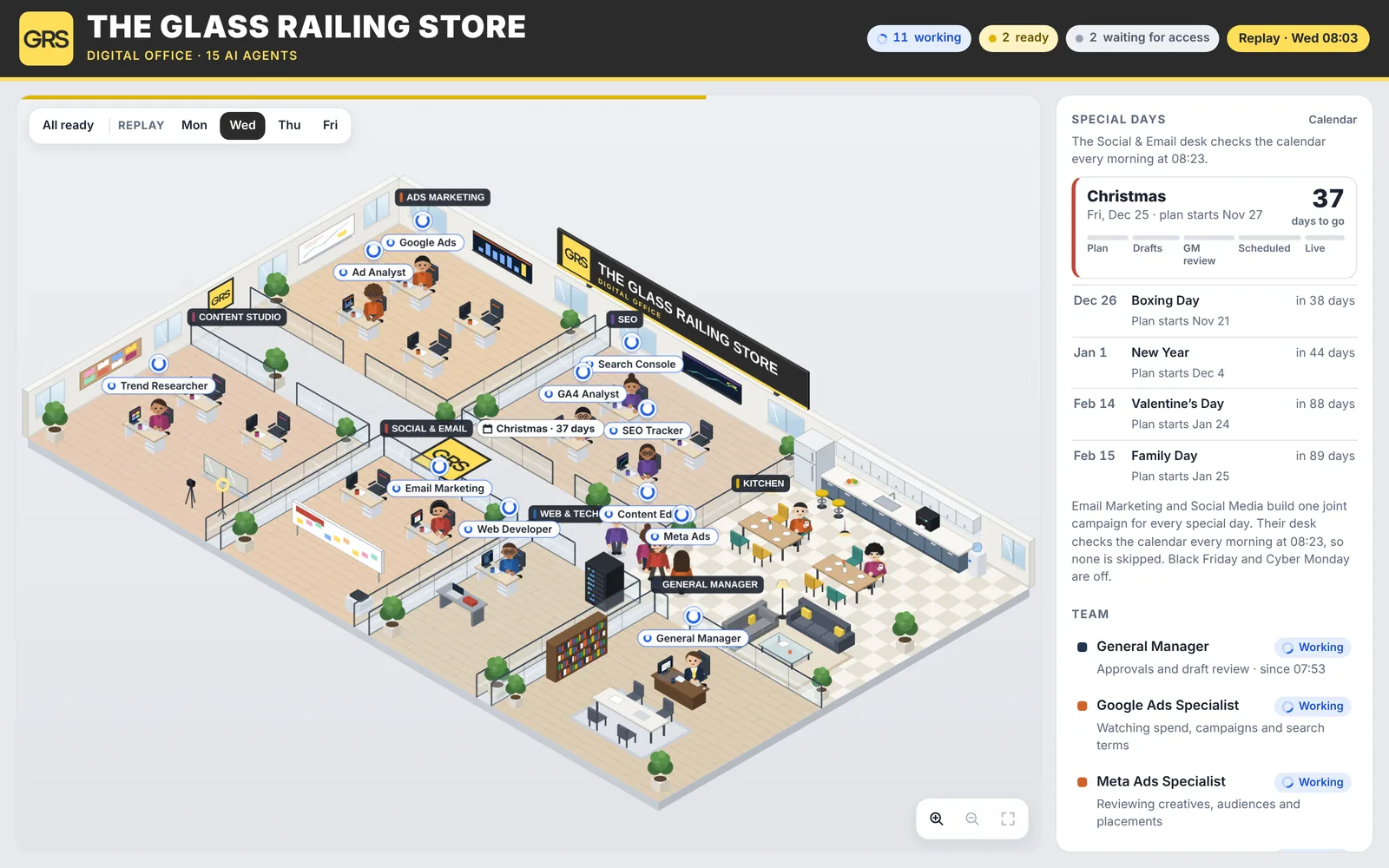
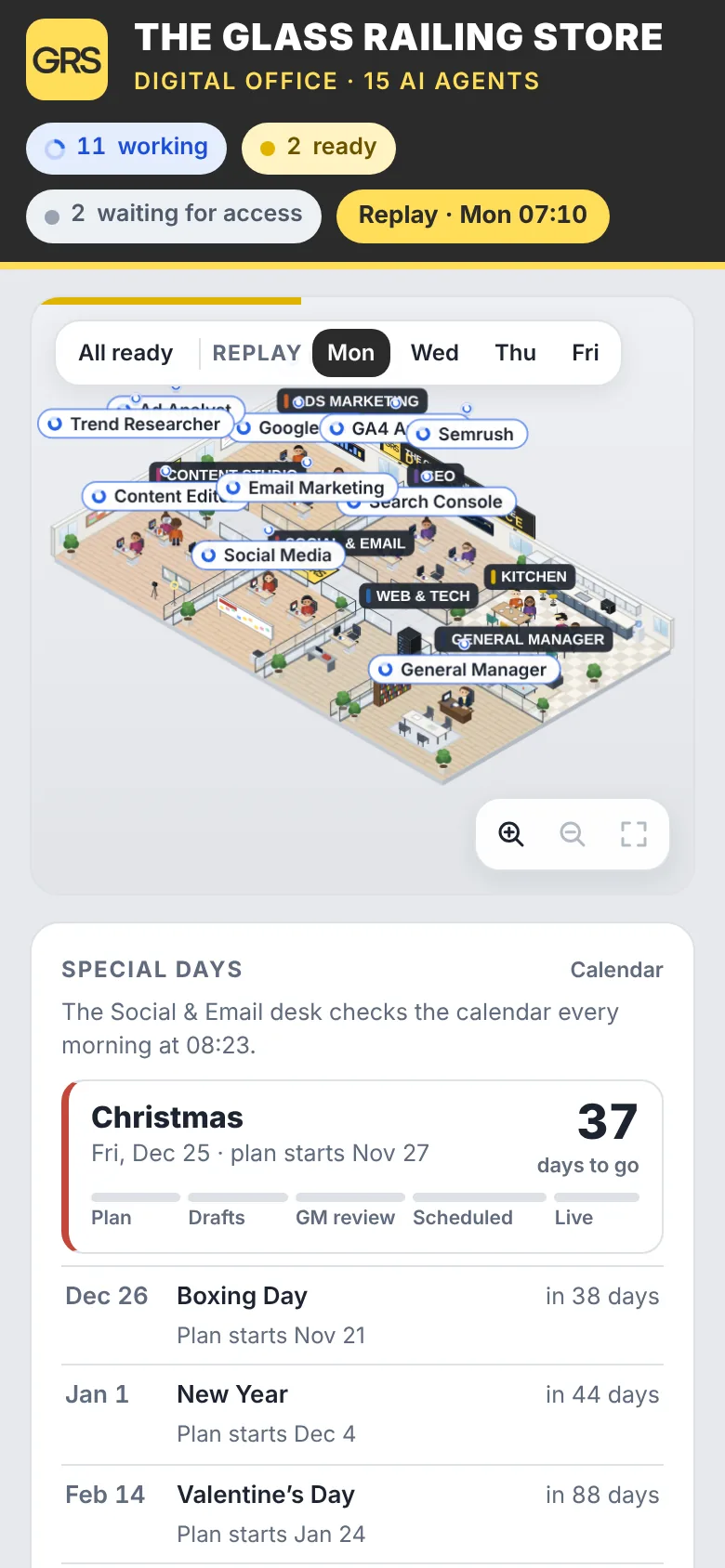
The interactive office is a hand-drawn isometric scene on one HTML canvas, with no libraries. It plays a Monday, a Wednesday, a Thursday and a Friday morning in a loop. An agent on a run shows a blue spinner and moves at its desk; when work changes hands, the agent carries the paper to the colleague’s desk and the two talk it through. On this site most desks stay at work between their runs, and two agents at a time take a break in the kitchen; the General Manager stays in his office. A panel counts down to the next special day, and All ready stops the loop. Hovering over an agent shows its job, tools and schedule, and the floor can be zoomed. It is a simulation of the real schedule, not live data.
A living portfolio for sales, photos, guides and videos for quotes, Meta, Google, Shopify and GA4 in one place, AI built in and access set per role.
SEO and AI search, Google and Meta Ads, content and AI tools for an online store that sells glass railings to DIYers and contractors.
Tell me about your business and what you want to change. A few sentences are enough, and I reply by email.
Ask Bugra’s AI
Powered by Claude, using this website
AI answers can be wrong and are not offers or advice. Please don’t share personal details in the chat. Privacy · Terms


