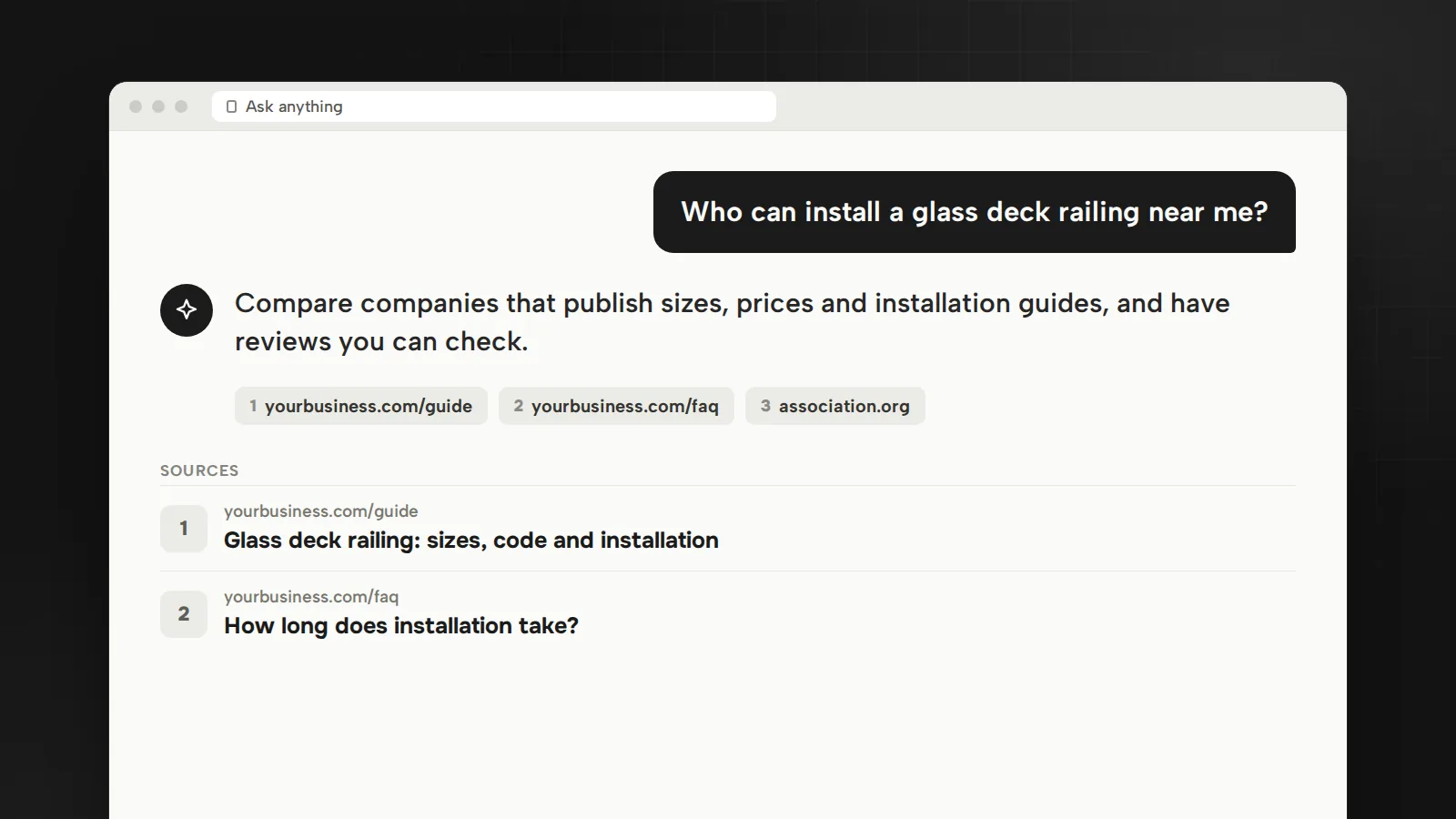
SEO has entered a new era. Google now answers many searches with AI before the list of links, and the old playbook of one keyword per post no longer works. To rank in 2026, businesses have to adapt to a world where:
- AI answers sit above the links for many searches
- Search intent changes faster
- Original content matters more
- Technical performance is a requirement, not a bonus
- Real human expertise is rewarded
This is the SEO strategy I recommend businesses follow in 2026 to stay competitive and visible.
Build topic clusters, not isolated posts
SEO is no longer about isolated blog posts that each target one keyword, and repeating a keyword doesn’t help: Google’s spam policies list keyword stuffing as spam. What ranks is depth on a subject.
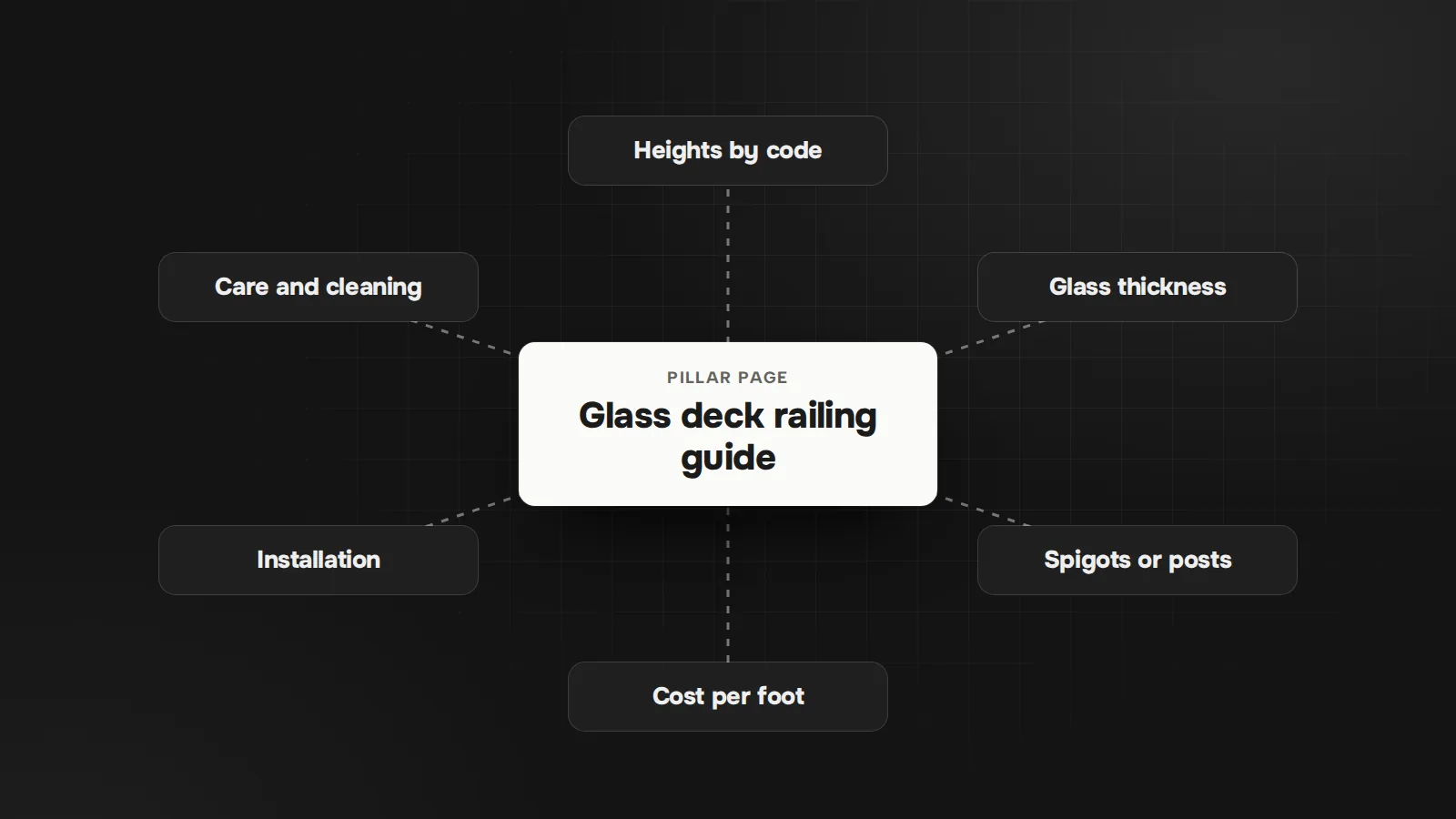
That is why I build topic clusters: content organized around one subject so that it signals expertise, relevance and depth. For competitive keywords, I treat them as essential. A cluster has three parts.
A pillar page
The pillar page is a complete, in-depth guide to a broad subject and the hub of the cluster. It:
- Defines the key concepts
- Gives a structured overview
- Links to every cluster post
- Answers the high-level questions
- Establishes your site as an authority
Because it is built as a complete guide, a pillar page also tends to attract links on its own.
Supporting posts
As a rule of thumb, plan 10 to 20 supporting posts, each going deeper into one subtopic from the pillar page. Each one should:
- Target a specific long-tail search
- Give detail the pillar page doesn’t
- Solve one real problem your buyers have
- Add depth to the main topic
- Link back to the pillar page and to related posts
Internal links across every post
Internal links hold the cluster together. Google says it uses links as a signal of relevance and to find new pages to crawl, and that every page you care about should have a link from at least one other page on your site. Good internal links:
- Help search engines find, crawl and understand your pages
- Show which pages matter most
- Guide readers to the next useful page
- Signal the depth and hierarchy of the topic
Use descriptive anchor text, as Google’s link guidelines recommend.
Why topic clusters work in 2026
Clusters outperform scattered posts for four reasons.
They show Google your expertise
Google says its ranking systems work at the page level, but that site-wide signals also contribute to how it understands pages. A well-built cluster gives Google:
- A clear content hierarchy
- A complete map of the topic
- A network of related articles
- Evidence of experience and expertise
It also suits AI Overviews and AI Mode, which can use what Google calls query fan-out: several related searches across subtopics to build one answer. Cover the subtopics and more of your pages can be found.
They keep readers on your site
A good cluster makes people read more than one page: they click through to related articles, stay longer and trust the content more. Google’s guidance asks whether readers leave feeling they’ve had a satisfying experience, and engaged readers are the ones who become leads.
They rank for many long-tail searches
Clusters are designed to capture:
- Variations of the same search
- Voice search questions
- Long, conversational searches
- Related subtopics your buyers care about
- The related searches Google’s AI features run behind the scenes
One strong cluster can rank for a wide range of searches and grow organic traffic steadily.
They beat thin AI content
AI tools can produce endless short posts, but they can’t copy human experience, strategic structure, real industry insight or organized depth. Google’s spam policies call it scaled content abuse when many pages are generated mainly to manipulate rankings instead of helping people, however they were made.
Prove your experience and expertise (E-E-A-T)
E-E-A-T stands for experience, expertise, authoritativeness and trustworthiness. Google says E-E-A-T itself isn’t a specific ranking factor, but its systems use a mix of factors to identify content that shows it, and trust matters most. With the web full of low-quality AI articles, showing who is behind your content, and why they know the subject, is how you stand apart.
Experience is the strongest proof. Google’s guidance asks whether content clearly demonstrates first-hand expertise and a depth of knowledge, so add what only you know: campaign results, project stories and lessons from years of work. For me, that is digital marketing, SEO, photography, content and paid ads. Lived knowledge beats theory.
Author pages matter too. Google strongly encourages accurate authorship information, such as bylines, and asks whether bylines lead to more information about the author. A strong author profile lists qualifications, certifications, client work, case studies and links to professional profiles, so readers see a professional with a track record, not an anonymous voice.
Use original visuals: your own photos, behind-the-scenes clips, short videos and screenshots from Google Analytics, Google Ads, SEO tools and real workflows, instead of stock or AI images. They prove the work is real.
Finally, publish testimonials and case studies. Before-and-after numbers, revenue growth, ranking results and campaign outcomes show measurable impact that buyers can check. Together, these position you as an expert in your field, not just someone who produces content.
Structure every post for Google’s AI search
The Search Generative Experience, Google’s AI test in Search Labs from May 2023, grew into AI Overviews, which Google began rolling out to everyone in the US in May 2024. AI Mode followed for everyone in the US in May 2025. Ranking in the blue links is no longer enough on its own.
In a Pew Research Center study of 900 US adults’ browsing in March 2025, 18% of Google searches showed an AI summary. When one appeared, people clicked a traditional result in 8% of visits, against 15% when there was none.
Google says there are no additional requirements or special optimizations needed to appear in AI Overviews or AI Mode, so the work is good SEO: posts that people, and Google’s AI, can understand quickly. In practice:
- Open each section with a short, direct answer
- Use subheadings that mirror how people ask questions
- Add FAQ sections and question-style headings where they fit
- Keep formatting clean and sections easy to scan
- Work related “People also ask” questions into the text
- Add comparisons, short summaries and well-placed data points
Businesses that write this way stay visible as more answers move into AI. Those that don’t risk disappearing beneath them.
Update, October 2026: At Google I/O on May 19, 2026, Google joined AI Overviews and AI Mode into one AI search experience. Its May 2026 guide to AI search says these features are rooted in its core ranking and quality systems, with no need to chunk pages or rewrite them for AI. More in SEO updates for 2027.
User intent is the new keyword strategy
Google’s own explanation of how it ranks results starts with intent: to return relevant results, it first needs to establish what you are looking for. Keywords still count, and Google calls them the most basic signal of relevance, but a page that only repeats a phrase won’t win. It has to fulfil the purpose behind the search and fit the reader’s stage of research.
Four types of search intent shape modern SEO:
- Informational: people want an explanation or a definition
- Commercial: people want to compare options before they decide
- Transactional: people are ready to buy
- Local: people need a nearby service or provider
Match the page to the searcher’s goal and it can rank, hold attention and convert. Miss the goal and no amount of keywords will fix it.
Long-form content: depth, not word count
With a flood of AI-generated posts on the web, depth, structure and human expertise are what set a page apart on competitive topics. Long-form content leaves room for real insight, original examples, visuals and first-hand advice that generic AI content can’t copy.
Length itself is not the target. Google says it has no preferred word count, and asks instead whether content gives a substantial, complete or comprehensive description of the topic. On competitive topics that usually takes a long article. Write until the question is fully answered, then stop.
Done well, long-form content builds authority, keeps people reading, adds internal linking opportunities and makes your site a trusted resource rather than a quick answer machine.
Backlink quality matters more than quantity
Google’s spam policies treat links made mainly to manipulate rankings as link spam, including buying or selling links for ranking purposes, and Google uses systems such as SpamBrain against spam. Link building in 2026 means earning real recognition with valuable content, not gaming the algorithm. The strategies that still work:
- Original data and research
- Long-form guides that others cite as references
- Infographics, charts and other visual assets
- Expert roundups with voices from your industry
- Local partnerships and community involvement
- High-quality, relevant guest features
Earned links are strong trust signals, and they last. That is sustainable, ethical SEO, not a shortcut.
Build video into your SEO
Video is part of search now. Google can show videos on the main results page, in Video mode, in Google Images and in Discover. A 30 to 60 second video summary on each post helps readers who would rather watch and gives you a clip for every other channel.
Know its limits, though. Google’s video features, such as video results and Video mode, need a watch page whose main purpose is to show one video, so a blog post with an embedded video isn’t eligible for them. Publish the full video on YouTube or its own page too, and turn the article into YouTube Shorts and Instagram Reels. My guide to short-form video shows how to use those clips to increase sales.
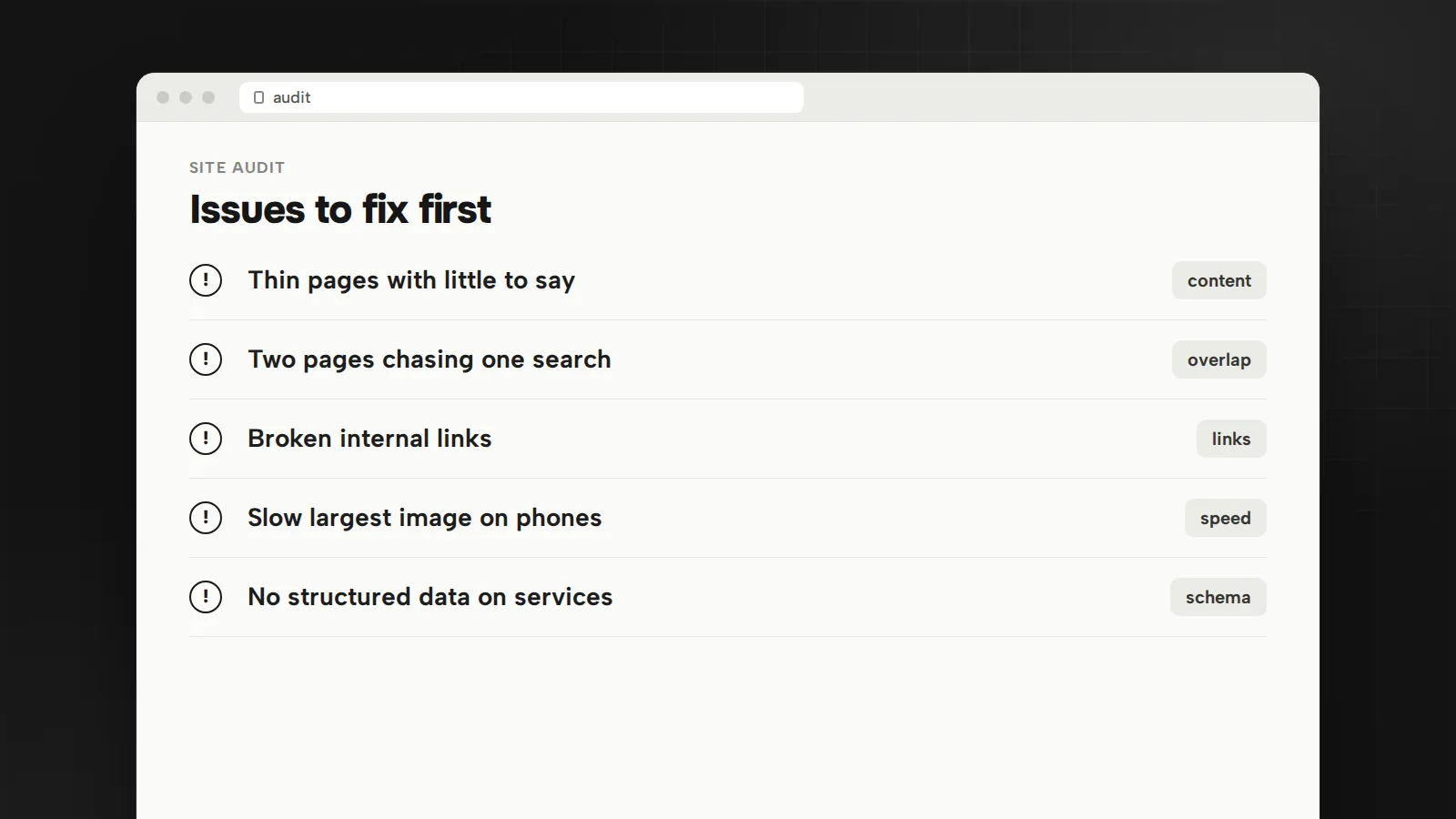
Technical SEO is the foundation
Google says it always seeks to show the most relevant content, even when the page experience is poor, but when lots of helpful content is available, a great page experience can contribute to success. Fast, stable, accessible pages are the base everything else stands on. What matters most in 2026:
- Core Web Vitals in Google’s recommended range: Largest Contentful Paint within 2.5 seconds, Interaction to Next Paint under 200 milliseconds and Cumulative Layout Shift under 0.1
- Images in WebP or AVIF
- Minimal, clean JavaScript and CSS
- Responsive layouts, because Google indexes and ranks the mobile version of your site
- Correct structured data for the rich results your pages qualify for
- Clean URLs and error-free redirects
- Strong accessibility, in line with WCAG
Content and code have to work together.
Update, October 2026: Google stopped showing FAQ rich results for every site on May 7, 2026. Keep FAQ sections that answer real questions, but don’t add FAQ markup expecting a rich result.
Local SEO starts with your Google Business Profile
Google says local results are based mainly on relevance, distance and how well known a business is. Treat your Google Business Profile as an active channel, not a static listing: Google says complete, accurate profiles are more likely to show up in local results, and that more reviews and positive ratings can help local ranking. Post updates, add photos of real work and reply to reviews.
On your website, city pages, local keywords and accurate citations add visibility. Give each city page real local content. Near-identical pages made only to rank for similar searches are what Google’s spam policies call doorway abuse.
For a local business, this is the SEO that drives real leads and revenue.
AI is a tool, not a replacement for human strategy
Google’s guidance says generative AI can be particularly useful for researching a topic and adding structure to original content, and warns that using it to generate many pages without adding value for users may violate its scaled content abuse policy. The best marketers use AI for outlines, structure, research and optimization, and rely on their own insight, experience and judgment for the content itself. The formula is simple:
- AI for support
- People for strategy, insight and originality
This mix produces content that ranks, converts and builds trust, which is what buyers now expect.
The 2026 SEO blueprint for businesses
Here is the strategy in its clearest form:
- Build deep, interlinked topic clusters
- Strengthen E-E-A-T with real experience
- Structure every page for people and Google’s AI features
- Match every page to the searcher’s intent
- Publish complete, authoritative content
- Earn quality backlinks with content worth citing
- Build short-form video into your SEO
- Keep technical performance excellent
- Win local search with an active Google Business Profile
- Use AI responsibly, with human editing
Businesses that follow it will stay visible and competitive in 2026 and beyond. I have since used this approach for Glass Railing Store and RF Transparent, which both reached the top two in Canada for organic Google visibility within 8 months. If you want a plan like this, it is part of my SEO and AI search service.
Sources
- Creating helpful, reliable, people-first contentGoogle Search Central, October 2026
- Spam policies for Google web searchGoogle Search Central, August 2026
- SEO link best practices for GoogleGoogle Search Central, December 2025
- A guide to Google Search ranking systemsGoogle Search Central, December 2025
- AI features and your websiteGoogle Search Central, December 2025
- How Google is improving Search with Generative AI (Search Generative Experience)Google, May 10, 2023
- Google I/O 2024: New generative AI experiences in SearchGoogle, May 14, 2024
- AI Mode in Google Search: Updates from Google I/O 2025Google, May 20, 2025
- Google users are less likely to click on links when an AI summary appears in the resultsPew Research Center, July 22, 2025
- Google Search at I/O 2026Google, May 19, 2026
- Optimizing your website for generative AI features on Google SearchGoogle Search Central, May 2026
- How Google determines ranking resultsGoogle Search
- Video SEO best practicesGoogle Search Central, December 2025
- Understanding page experience in Google Search resultsGoogle Search Central, September 2026
- Understanding Core Web Vitals and Google search resultsGoogle Search Central, December 2025
- Mobile-first indexing best practicesGoogle Search Central, December 2025
- Latest Google Search documentation updates (FAQ rich results, May and June 2026)Google Search Central
- Tips to improve your local ranking on GoogleGoogle Business Profile Help
- Google Search’s guidance on using generative AI content on your websiteGoogle Search Central, October 2026

Bugrahan Unsal is a B2B and B2C marketing director in Toronto. He leads marketing for Glass Railing Store and RF Transparent and builds AI tools and websites. More about Bugrahan.
Follow on LinkedIn (opens in a new tab)