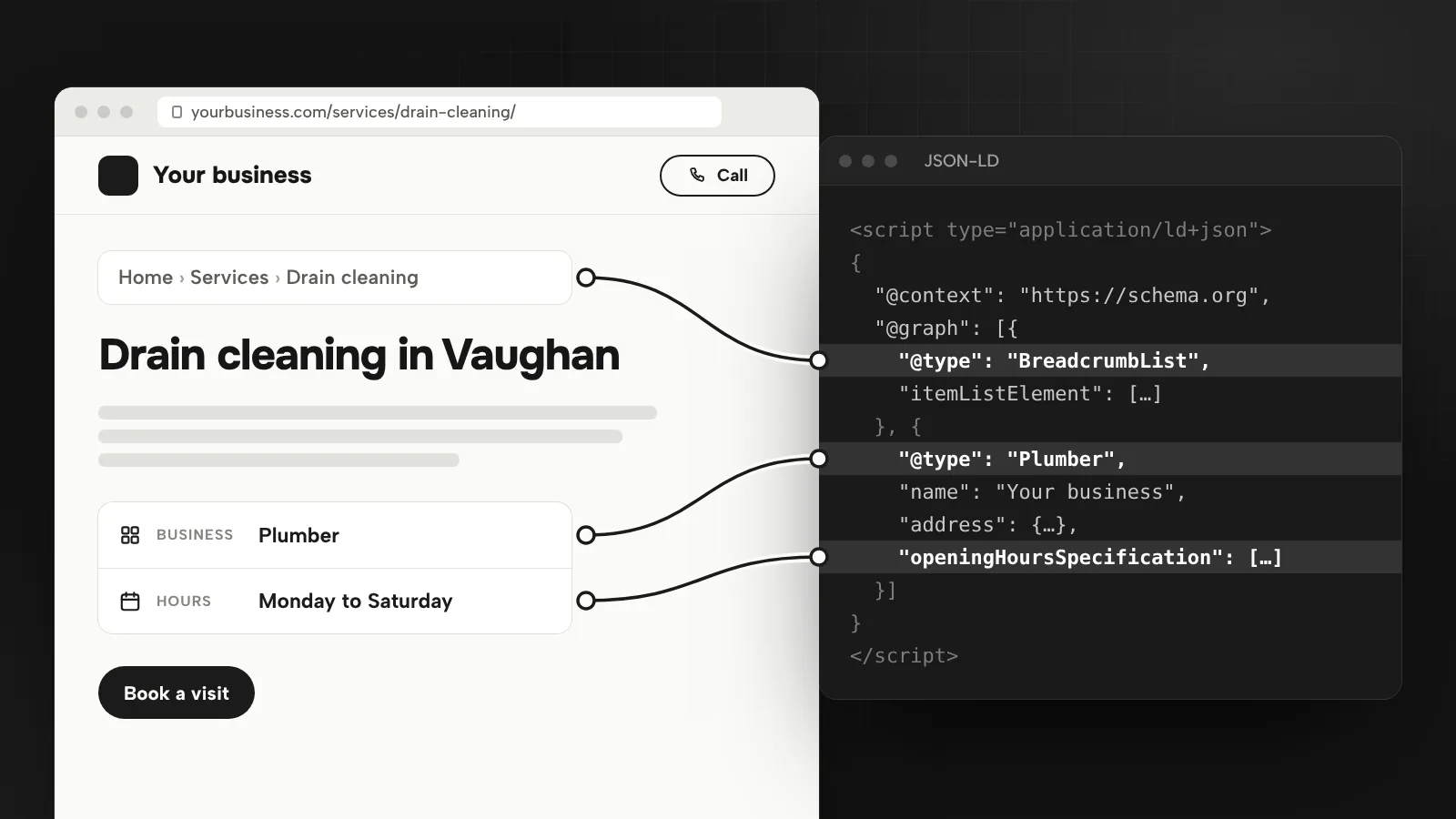
Schema markup, or structured data, is code that describes a page in a vocabulary search engines share, schema.org. It tells Google that a page belongs to a plumber in Vaughan who is open from 8 to 6, instead of leaving it to work that out. Here are the types worth adding to a small business website, the ones to stop worrying about and how I put it in place.
What schema markup does, and doesn’t
Google says it uses structured data to understand the content on a page and to show that content in a richer appearance in search results. Its search gallery lists the features it supports, 25 of them as of October 2026, from Article and Breadcrumb to Local business, Product, Review snippet and Video.
Two limits matter. Google’s documentation is clear that features using structured data are not certain to show up in search results. And markup describes the page; it doesn’t replace it. If the hours in your code differ from the hours on the page, or from your Business Profile, the markup is wrong, and fixing it is the job.

LocalBusiness or Organization: describe the business
This is the one type nearly every small business site should have. I use LocalBusiness when customers visit the business or it serves a local area, and Organization for a company without a local presence; Google’s gallery describes Organization markup as information such as your logo, legal name and address. For LocalBusiness, Google asks for the most specific subtype possible, such as Plumber, Electrician or Restaurant, and its example for a business of several types lists them together.
The properties I fill in:
nameandaddress, the two Google requires.telephone, the main number customers call, andurl, a working link to the page for that location.openingHoursSpecificationfor your hours. Leaving out the start and end dates tells Google the hours apply all year.geo, with latitude and longitude to at least five decimal places.priceRange, under 100 characters, if you can give one.departmentfor parts of the business with their own details, such as a showroom with different hours.
Google says this markup can tell it about business hours, departments and reviews, and that search results may show a knowledge panel with details about a business. The same name, address and phone number belong in the markup, on the page and on your Business Profile; my Google Business Profile checklist covers the profile side.
Breadcrumbs, articles and video
- Breadcrumb markup shows where a page sits in the site, such as Home › Services › Drain cleaning. Google’s documentation has said since January 2025 that breadcrumbs appear only in desktop results. It is cheap to add if your pages already show breadcrumbs.
- Article markup for blog posts and guides: the headline, the dates and the author. Google lists it for news, sports and blog articles.
- Video markup for pages built around a video, so Google can show it with the option to play it and with video segments.
Products, events and reviews
- Product markup for anything you sell online: in the gallery’s words, price, availability and review ratings. Keep it identical to the visible price and stock.
- Event markup if you run classes, open houses or other dated events; Google can show them in a list of organized events.
- Review snippets need care. Google’s review snippet guidelines say that when a business controls the reviews about itself, on its own site or through an embedded third-party widget, it isn’t eligible for star ratings with LocalBusiness or Organization markup. Since 2023, the LocalBusiness documentation has recommended review markup only for sites that capture reviews about other local businesses, and the guidelines now say not to include fake or undisclosed incentivized reviews on the page or in the markup.
So keep testimonials on your pages, where people read them, but don’t mark them up for stars on your own business.
Types Google no longer shows
Several features that sites still mark up no longer appear in Google Search:
- FAQ rich results stopped appearing for every site on May 7, 2026. Since September 2023 they had appeared only for well-known, authoritative government and health websites.
- HowTo rich results: Google removed their documentation in September 2023, because the feature no longer appeared on desktop or mobile.
- Course info, estimated salary, learning video, special announcement and vehicle listing: Google announced in June 2025 that it was phasing them out, and removed their documentation that September, saying they are no longer shown in results.
Keep FAQ sections that answer real questions, because people read them. Just don’t expect the markup to change how the page looks in Google. If a plugin or theme adds FAQ or HowTo markup automatically, it isn’t earning you anything in Search.
How I add and test it
- Write it as JSON-LD in the page’s HTML, generated from the same data as the visible page, so the two can’t drift apart.
- Validate it with Google’s Rich Results Test and fix any critical errors, as Google’s LocalBusiness guide says.
- Deploy a few pages first and check them with the URL Inspection tool in Search Console to see how Google sees them.
- Submit a sitemap and allow time: Google says it can take several days for it to find and crawl a new page.
- Check again after every redesign or plugin change. Themes and plugins add markup of their own, and two of them can describe the same business twice.
On the Demir Mechanical website, every page carries structured data for the business, its services, breadcrumbs and FAQs, and the whole site is generated by one build script, which keeps shared details identical across its 33 pages. The Lumen Painting website has SEO settings for every page in its admin, and the Bloor West Medspa website gives every treatment its own page, in English and French. Pages with one clear subject are the easiest to describe accurately.
What I would do first
Run your home page and one service page through the Rich Results Test. If there is no LocalBusiness or Organization markup, add it. If there are errors, fix them. If a plugin adds FAQ or HowTo markup, keep the content and stop counting on the markup. Then check that every detail matches your Business Profile.
Structured data is part of the technical work in my SEO and AI search service and is built into every website I build. For how it fits into AI search, see how to get cited in AI answers, and for the local side, local SEO in Toronto.
Questions
Is FAQ schema still worth adding?
Not for Google’s rich results: they stopped appearing for every site on May 7, 2026. Keep FAQ sections that answer what customers ask, because people read them, but don’t add FAQ markup expecting it to change how your page looks in Google.
Can I mark up my own reviews or testimonials for star ratings?
Not for stars on your own business. Google’s review snippet guidelines say a business that controls the reviews about itself, on its site or through an embedded widget, isn’t eligible for star ratings with LocalBusiness or Organization markup. Keep the testimonials on the page for people to read.
Which schema type should a service-area business use?
LocalBusiness, with the most specific subtype available, such as Plumber or Electrician; Google’s example even combines several. Fill in the name and address, which are required, plus phone, hours and the page URL, and keep every detail identical to your website and Business Profile.
How do I check if my website has structured data?
Test a page in Google’s Rich Results Test and fix any critical errors, then check a few live pages with the URL Inspection tool in Search Console. Test again after a redesign or a new plugin, because both can add or duplicate markup.
Sources
- Structured data markup that Google Search supports (search gallery)Google Search Central, October 16, 2026
- Local Business (LocalBusiness) structured dataGoogle Search Central, September 8, 2026
- Review snippet (Review, AggregateRating) structured dataGoogle Search Central, September 8, 2026
- Latest documentation updates (FAQ, HowTo, breadcrumbs, local business reviews and the 2025 phase-outs)Google Search Central

Bugrahan Unsal is a B2B and B2C marketing director in Toronto. He leads marketing for Glass Railing Store and RF Transparent and builds AI tools and websites. More about Bugrahan.
Follow on LinkedIn (opens in a new tab)